Monday, January 20, 2020

The Gratitude of the Goose

Once upon a time an old man lived on the shores of Lake Jyusan on the Tsugaru Peninsula of Aomori.

One winter's night the man heard a knocking at his door. Opening it, he beheld a young girl standing in the blowing snow, covered in white from head to foot.

"Oh, my. What are you doing out on a night like this? Do come in."

He stirred up the fire and bade his guest warm herself by the hearth. Looking at the girl more closely, he noticed that one of her feet was bleeding.

"Is your foot hurt?" he inquired.

"Yes, I stepped on a hunter's trap by accident."

"That's rotten luck. Would you like to stay here until it's better?"

"Oh, yes. Thank you ever so much," she replied.

"Look here, dinner's ready. Let's eat."

The old man served the girl a bowl of piping hot fish soup, which she quickly devoured. Then, curling up by the fire, she was soon asleep.

Later that evening, thinking to cover her with a futon for added warmth, the man discovered his visitor was not a young girl but a goose. "So that's how it was. Injured, she became separated from the other geese, and before coming here she changed into a human girl", ran the old man's thoughts. Smiling with this knowledge, he applied a healing salve to his guest's injured foot.

The snowy weather continued, but at last, a day of clear skies dawning, the goose-girl bowed deeply to the old man and said, "For many a day you have treated me with great kindness. Thanks to you, my foot has healed. As I am now able to resume my journey, I will soon be leaving you."
"Is that so? You're going?" 
The girl was saddened to perceive how deeply affected the man was by her announcement.
"I've kept a secret from you all this time. The truth is, I'm a goose."
"Ahh. But you see, I knew that," the man replied.
"You did? I'll never forget your kindness."

With that, the girl became a goose again and rose into the sky. After thrice circling above the old man's house, the goose, now a mere speck in the sky, flew northwards

Then it was spring, then summer, then fall, and the time of year geese begin appearing in the region of Lake Jyusan. When the old man beheld the first geese on their southward journey, he was reminded of his visitor earlier that year. 

One day the man noticed a goose veer from its traveling companions and head in his direction. When the goose was overhead, something fell from its bill to the ground. Retrieving the item, the man found it to be a small packet containing some gold dust and a letter. Unfolding the latter the man read, "Thank you, Grandpa, for your many kindnesses. Take care of yourself."
 
With a tear in his eye, the old man watched the goose until it passed from sight.
"You, too," he said.
 

Image result for 津軽十三湖"
Lake Jyusan, Aomori

Monday, December 16, 2019

Gutsu and the Crow- A Japanese Folktale

Long, long ago, a boy named Gutsu lived in a village with his grandmother. One day, his grandma said, "Gutsu, as today is your late grandfather's death day, we must summon a priest to chant the sutras in his honor. Won't you run along to the neighboring village to ask for the priest there?" "What's a priest?" inquired the little boy, for Gutsu's village did not have a temple. "He's a man who wears a black kimono." "I got it," replied Gutsu. Heading through the rice fields, Gutsu came upon a large crow perched atop a scarecrow- and crows, as everyone knows, are black. "There he is!", exclaimed Gutsu. "Hey you, Mister Monk, hey, come with me," he shouted. The crow, startled, took wing and flew off.  "Where are you going?", Gutsu cried. Running after the crow, the boy soon found himself outside a temple. "Mr. Priest, I know you're in there. Hurry up and come out," whereupon Gutsu found himself face to face with the real thing. "I'm the priest. What do you want?"  "So priests are human," thought Gutsu. Haltingly the boy explained his errand, and the priest accompanied him home. The old woman, who rarely found cause to praise her grandson, did so that day: "Well done, Gutsu. Good boy."

Monday, December 09, 2019

Tattoos and Onsen

This poorly written and researched article on tattoos exemplifies the low editorial standards at Japan Today. If you read through to the end and felt no more informed than at the beginning, the answer to 'Can onsen, swimming pools, sports clubs, and similar facilities bar those with tattoos?' is "It depends".

Public facilities may not bar tattooed patrons. Full stop.

Private facilities may do so at their discretion.  

Sunday, November 17, 2019

Matsuo Basho

In the year 1689, haiku poet Matsuo Basho departed Edo on what would be a two-year journey to the north of Japan. The collection of prose and travel verse inspired by the excursion yielded 奥の細道, or Narrow Road to the Interior. Basho spent a week at Mt. Haguro at Minamitani, or South Valley, at a temple no longer existing.


Path to South Valley

South Valley, where Basho spent a week in 1689

Wednesday, November 13, 2019

(Some of) The 2446 Steps


Pics from Haguro

Yamabushi Pilgrim

Photos from Mt. Haguro


Shrines and Cryptomeria


Mt. Haguro

Mt. Haguro, located on the outskirts of Tsuruoka City, Yamagata Prefecture, is sacred to shugendo, a belief system which is perhaps best described as an amalgam of Buddhism, Shinto, and ancient Japanese beliefs. Practitioners, or yamabushi, believe in the restorative and regenerative power of nature and of mountains in particular. Mt. Gassan and Mt. Yudono, both nearby, form a holy mountain trinity with Haguro known collectively as Dewa Sanzan, the three mountains of Dewa, the old provincial name of the prefecture. Pilgrimages undertaken to the area to experience renewal and rebirth- 生まれかわりの旅, as a sign above the entrance to the local culture museum puts it- begin at Haguro, which represents one's present life. The next stop on the pilgrimage route is Mt. Gassan, the highest of the group, signifying the past, with Mt. Yudono (the future) the last.


Sanjingosaiden Shrine, Mt. Haguro, and the largest thatch roof in Japan
       

Sunday, June 23, 2019

Soba Made Simple


Total time approx. 15 minutes


Monday, May 27, 2019

"The Truth about Wasabi", a Short Video

Highly recommended: https://www.theatlantic.com/video/index/585172/wasabi-fake/

Izumozaki, Niigata: Basho, Ryokan-sama, and Grilled Fish

The town of Izumozaki in Niigata Prefecture has much to offer: haiku poet Basho spent a night there (commemorated by the sign pictured, which includes a haiku the poet wrote after gazing seawards from the window of his room) at "Travelers' Inn Ozaki-ya" in 1689 during the tour of northern Japan that inspired Narrow Road to the Interior; nineteenth-century poet and calligrapher Ryokan-sama was born in Izumozaki- be sure to visit the monument (shown below) and nearby museum curating his work, and the Ishii Fish Shop, which serves up local catch (from the Sea of Japan- of which there are wonderful views from the town) freshly grilled.

The haiku (inexpertly rendered):

The turbulent sea
Stretching to Sado Island
The glittering sky

Basho Memorial

Ryokan-sama Memorial

Grilled Saba from Ishii-ya

View of Sea of Japan (Sado Island just visible at right)

Monday, April 22, 2019

Black Ships and Dancing Girls

Shimoda, a city at the tip of the Izu Peninsula in Shizuoka Prefecture, was one of two ports (the other being Hakodate) opened to the outside world in 1854 with the signing of the Kanagawa Convention between the Tokugawa Shogunate and the US government. The first US consular office was located at a temple in the city and manned by Townsend Harris, who was later instrumental in negotiating the Treaty of Amity and Commerce between the two countries.

The limited express linking Tokyo to Shimoda is named Izu no Odori-ko, or "Dancing Girl of Izu", which evokes the short story by Yasunari Kawabata and its title character. I can't think of a lovelier or more appropriate name for this train.


Monday, January 28, 2019

A hand towel, a monk, and the first alpinist


Pictured is a hand towel, or tenugui (手ぬぐい), commemorating 1,300 years since Mt. Haku (2,702 m) was first climbed. Taicho, known as "The Monk of Echizen", accomplished this feat of mountaineering in the year 717: in other words, over 600 years before Petrarch (he of the sonnets to Laura in the style that bears his name) became the "first" alpinist in the modern sense (that is, climbing mountains to enjoy the views, among other things) by scaling Mt. Ventoux (1,912 m) in 1332. Whether Taicho admired the views from the top of Mr. Haku (which, by the way, straddles Ishikawa, Gifu, and Fukui prefectures and has been considered sacred from ancient times) is, well, irrelevant. In 717 there were no climbing routes, so Taicho had to blaze his own trail. In the following century three paths were established, one starting in each of the three prefectures (not then known as "prefectures", if you care about such things) mentioned above. Nice hand towel/ wall decoration.  Tenugui make good souvenirs, too.     

Sunday, January 13, 2019

New Year's Decorations: the Kadomatsu

Examples of kadomatsu flank the entry to a trad villa in downtown Niigata City.
For a discussion of the "gate pine" and other decorative elements, see the earlier post titled The Japanese New Year.


Tuesday, January 01, 2019

Poet and Priest Ryokan-sama

From a 2009 post:

One morning death comes before
They can use even half their money.
Others happily receive the estate,
And the deceased's name is soon lost in darkness.
For such people there can only be great pity.

Well, I get the idea about the pity, even if it is tough to feel in this case.


Tuesday, December 25, 2018

Karin, or Chinese Quince


Karin (花梨) may be available at a grocery near you- or on the ground, as were the two I collected on my way to work a few days ago. Called Chinese quince in English, the fruit is used to make jams, syrups, and flavored spirits and is included as an ingredient in some throat lozenges as well.  


Wednesday, June 06, 2018

Weekend Cycling

Pics from June 3.

                                    Destination: Mt Sumon, Niigata,

                                               Roadside Shrine
                                         Rice paddy recently planted 
                                       
                                    Tough climb to reach the lake (700 m)

Tuesday, June 05, 2018

Photos of Shirakawa Village, Gifu

Photos taken at World Heritage Site Shirakawa-go, Gifu.


Tuesday, May 29, 2018

Religion in Politics

The Komeito Party in Japan is the political wing of Sokkagakkai, the Buddhist lay organization. It is the junior partner in Prime Minister Abe's administration and is expected to moderate the nationalist extremes to which some in Abe's party are tempted. Here's wishing Komeito luck.

Speaking of religion, Christians in America have a stark and simple choice: either take up the cross and follow Christ, or lay the cross down and follow Trump.

Here endeth.   

Monday, May 28, 2018

Photos from a Recent Outing on the Bike


     Jokoji, Kamo City, the family temple of Steve Jobs' Zen master,                             Kobun Otogawa

dilapidated farmhouse and kura- the original thatch roof of the former has been covered with tin

the only remaining rolling stock of the defunct Kambara Railway, Japan's first all-electric line- taken in Kamo City, Niigata; the foremost carriage is the oldest wooden car in the prefecture


Thursday, May 24, 2018

Japan by Bike and Glimpses of Japan

Japan by bike now posts on Glimpses of Japan.

From a post entitled "On the Road Again."

Japan by Bike is back, albeit without Don, who a couple of years ago returned to his native New Zealand. So for the time being it's a solo effort, dear reader. The colorful commentary of my erstwhile cycling partner will be missed, but I trust Japan by Bike will continue to convey the pleasures of discovering the country on two wheels.

Afternoon Ride: a Post from Japan by Bike

A few photos taken during a recent afternoon ride. Severe winter weather in the area felled trees, which block a spur of a local rindo, or forest roadThese roads, usually gravel but sometimes sealed, offer excellent cycling but are often sketchy come springtime until crews can get out and clear or repair them.


Houses like this are a common sight in rural Japan.


skunk cabbage


A paved section of forest road.

Tuesday, March 06, 2018

The HS Entrance Exam: Today is the first day of the rest of your life

It comes down to today and tomorrow, March 7-8 this year in Niigata, the culmination of 9 yrs. of compulsory education, the last 3 of which were primarily a preparation for the high school entrance exam and additional years of "elective" schooling. I'd venture to say every jr high 3rd-year who sat the exam has an insurance policy, a Plan B, or what is referred to as a suberiko (滑り校), or suberitomeko  (滑り止め校), the private school (In Niigata City there are 8 from which to select) chosen by students that will arrest their fall should they fail to gain admission to a public school. Otherwise... Official exam results to be announced next week. Students will nevertheless have an accurate sense of their performance, as local newspapers publish the test questions and answers the following day, but whether a student's overall score is good enough will remain unknown, resulting in several days of anxiety, for many.. 

Sunday, February 18, 2018

Tax Season

For third-year students this time of year means entrance exams, for their parents, taxes.  The artwork shown includes some of the winning entries in a local "tax awareness" poster contest for primary school 6th graders.

Gold: "Taxes are for everyone's happiness."

Silver: "Taxes are one of the pieces in the jigsaw of the future."

                               Bronze: "Taxes are the source of smiling faces."

The favorite of the head of the local tax authority: "Taxes make the town peaceful."

               
These artists (11-12 years old) understand that 1), taxes pay for things such as public schools, parks, infrastructure, police, health care, etc., and 2), the business of government is to provide such things for the common good. This is, simply, civics education at work.   Provides a telling contrast with the US, where voters demand that their representatives order the government keep its hands off Medicare while cheering the defunding of federal programs. 


Monday, February 05, 2018

The Entrance Exam- the Gift That Keeps on Giving

It's almost as though the current entrance exam regime was devised by the for-profit education industry. Does your child aim to enroll in one of the better (in terms of hensachi)public high schools? If so, it's off to the ATM you go, for entrance exam prep offered by the neighborhood middle school is insufficient. You want the cram school professionals for this job.  The good folks at Nokai, a national juku chain, charge between 11,000 and 42,000 yen monthly for jr. high 3rd graders. With many middle school seniors attending cram school from August, some 8 months prior to the public high school entrance exam, families can be set back as much as 10% of a typical salaried worker's annual salary.  Or more than two month's take- home for a parent among the growing ranks of Japan's working poor.

Monday, January 15, 2018

More Dispatches From Exam Hell

A digression:

So why the massive difference in admissions standards at prefectural high schools?

In Japan, attendance zones determine the primary or middle school to which a child is sent, but when compulsory education ends with junior high school graduation, admission to upper-secondary school becomes competitive, or "meritocratic".

(While it is true that attendance zones no longer apply after middle school, a student's home address is nevertheless a fair predictor of who will not enter an elite high school- see a recent piece in the Japan Times by Philip Brasor about how this plays out in the Tokyo real-estate market.) 

Back to "meritocratic", because if you are not, dear student, blessed with a photographic memory but instead are merely one of the sharper pencils in the box and come from a family that lacks the means to send you to cram school (juku), your chances of entering one of the better college-prep prefectural high schools diminish accordingly- as does your shot at enrolling at a public or more selective private tertiary institution- as do your chances of enjoying financial security later in life.


Entrance Exam Hell, It's More Hellacious Than You Thought: High School Edition

It's entrance exam season in Japan. Last weekend (January 13-14) students hoping to enter one of the country's public or private (the more prestigious variety) institutions of higher learning sat the National Center Test for University Admissions, known colloquially as the center shiken or center nyushi.

But let us consider for the nonce the high school analogue (held in March) to the center test, the koko nyushi, or high school entrance exam. (In this and following posts I shall refer to the situation as it exists for public schools in Niigata prefecture.)

First, a couple of key terms (applicable nationwide):

1) hensachi (偏差値): the figure that corresponds to the percentage of correct answers on the entrance exam needed to gain admission to a particular public high school; the range in Niigata is from 35 to 75, roughly, with selective high schools (and academic programs within schools) at the top of the scale

Niigata High School, the public high school in the prefecture with the highest admissions standards, has a hensachi of 73 for its Science and Math Course and 71 for its General Academic Course; the two are ranked 1 and 2, respectively, out of 142 schools and programs in the prefecture

Matsudai High School: at the other end of the scale with a hensachi of 35 

2) bairitsu (倍率): the (over-) subscription rate; the more popular schools and programs have the highest bairitsu; currently, Bandai High School's English/ Science-Math Course has a bairitsu of 2.4 (In other words, there are 2.4 times as many applicants as there are available slots for this popular program, so there will be many unhappy students and parents when exam results are announced.)

At the bottom of the ladder is Shiozawa Commercial and Technical High School with a bairitsu of 0.4. 

... more to come

Tuesday, December 12, 2017

A Folktale for the New Year, or Why Japanese Eat Black Beans at New Year's

Long ago in the mountains of Niigata Prefecture (or Echigo Province, as it was then called) lived a man known far and wide for his honesty. He farmed a meager patch in the mountains, growing black beans in poor soil, and just managed to eke out a living.  One winter's night, on the second of January, the man had his first dream of the New Year, and this is what he dreamt.

In the dream God appeared to him and said, "Hey, you, you're always working in that field of yours, and yet at the end of the year you're no better off than at the start. Listen to what I'm saying to you: There's a chap that lives in the village the other side of the mountain. He's got a garden, and in that garden is a plum tree.  You just take a shovel with you and dig around a bit under that tree and see if you don't find a pot of gold buried there." 

The next day he set out for the village, cautiously excited and more than anything curious.  It was getting dark when he arrived, but he found the house and knocked on the door. It was opened by the homeowner himself. "Excuse me, sir, but God told me in a dream about this house and the plum tree in the garden.  He said that if I dug around under the tree I'd find a pot of gold. If that's true, we'll go halves. What do you say?"

The other replied, "It's late, too dark to be digging up the garden. Why not in the morning?  You can stay the night here."

As soon as his guest was in bed, the man rushed out, grabbed the shovel, and began to dig. He dug and he dug, but for the life of him he could not find the pot of gold the visitor had dreamt was under the plum tree. 

The next morning the man told his guest about his fruitless search. "Honestly, I would have shared any treasure I found," he assured him. "Once I thought we were in luck, for my shovel struck something hard. But it was nothing, though I could have sworn a kind of black mist rose out of the ground."

"Just goes to show that some dreams are only dreams," said the other. "Sorry for putting you out." And thanking his host for the hospitality, the man set out to return home.

On the trail he encountered a strange gentleman dressed in black. "Good day, sir. And where might you be headed?" he inquired. The stranger pointed in the direction of the man's home. "Well, as it will be dark soon and unsafe to continue your journey, please do me the honor of sharing my humble abode this evening." And so the two descended the mountain towards the man's village.

"Were you out for a walk?" the strange man at length inquired.

"No, it wasn't that," the other answered, proceeding to relate the tale of his dream and the pot of gold that wasn't.  "But it's just as well, he concluded, I only know one thing in life, farming my small garden, and to be honest I not sure what I would have done if I'd found all that money."

At which the other smiled to himself.

Before long they reached the man's home. He fired up the hearth, set a pot of rice porridge to simmer, and busied himself making his guest comfortable.

The next morning the man in black was nowhere to be found. When our hero peered under the futon where the man had slept, imagine his surprise to find a gold jar stuffed to overflowing with pieces of gold. "It seems the jar I dreamt about turned into that mysterious man. And now my dream has come true," he mused.

With the money he purchased other plots, hired farmhands, and planted row upon row of black beans, which were highly prized. The honest farmer came to be known as "Black Bean Tycoon".

And this is the reason black beans are a New Year's tradition, expressing as they do the wish to be as healthy, wealthy, and hardworking as the hero of our tale.


Monday, October 09, 2017

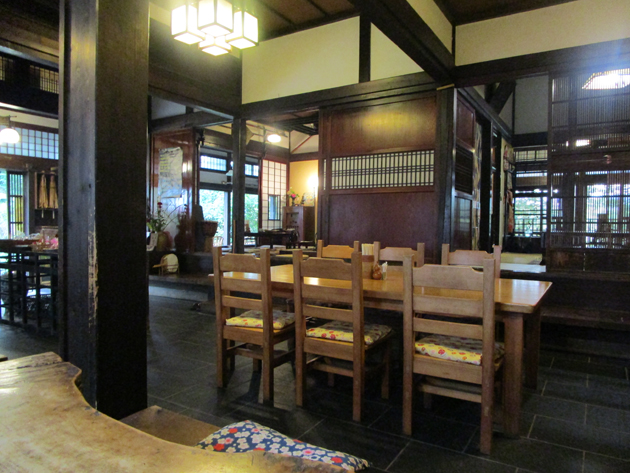
大松庵 蕎麦屋 Daishoan Soba-ya, Tsuruoka, Yamagata

Soba-ya Daishoan is located near Mizusawa Station in Tsuruoka, Yamagata. Housed in a trad former farmhouse, 大松庵 offers a selection of hot and cold soba dishes with buckwheat noodles handmade on the premises.The atmosphere is serene in the best soba-ya tradition.

大松庵 鶴岡 に対する画像結果


Friday, March 11, 2016

Great Tohoku Earthquake and Tsunami

The earthquake and tsunami have claimed 21,865 lives, to date. This figure includes 2561 individuals who remain officially missing as well as 3410 persons who died later owing to disaster-related complications. The number of residents of temporary, pre-fab housing is 57,677, while that of evacuees stands at 174,000. As I wrote earlier, this situation is definitely not under control.

Thursday, March 10, 2016

3/11, Five Years On

By 2:48 the continuous shaking had stopped, but we waited outside another ten minutes, just to be sure.  Then the three of us ALTs and our soon-to-retire Japanese advisor headed back into the three-storey governmental building we (and dozens of others) had vacated some fifteen minutes earlier, reversing our evacuation route to a cramped room on the top floor, where we reconvened and shortly ended our interrupted quarterly meeting.  All we knew at the time was that a massive quake in Tohoku, Japan, had generated an unusually prolonged tremor measuring five in Niigata City, hundreds of kilometers away.

 More than two hours would pass before I first learned of the killer tsunami, which by then had already begun devastating coastal communities in northeastern Japan.  In the days to come, horror would follow horror, culminating in catastrophic damage to Fukushima Dai-ichi.

 Five years on, and the reconstruction of Tohoku has been spotty, to say the least.  Thousands remain in temporary housing.  Thousands more who lived within the evacuation zone in Fukushima are unable or unwilling to return.  And the situation at the nuclear plant is decades away from being completely under control.