A more common sight in Japan than even the ubiquitous convenience store is the roadside shrine (Yes, I know, a most bold assertion). Such shrines come in all manner of upkeep and repair. I pass numerous wayside shrines on my commute, most of them tidy and of weathered, untreated wood, and lacking in any ornament or statement of artistic originality.
Not so this shrine.
The shrine, with its figure of Jizo, bell pull, flowers, and general appearance, is not unlike others I pass on the ride to school. However, the artist/ builder has let himself go on the "pediment" (What is this part of the shrine called, by the way?), writhing, serpentining figures and all.
Jizo is the protector of travelers, women in childbirth, and children. According to Buddhist thought, the souls of children who die during childbirth or at a young age are sent to sai no kawara , a dismal place where they must erect piles of stones, which are promptly scattered by demons. Someone has erected such a pile here.


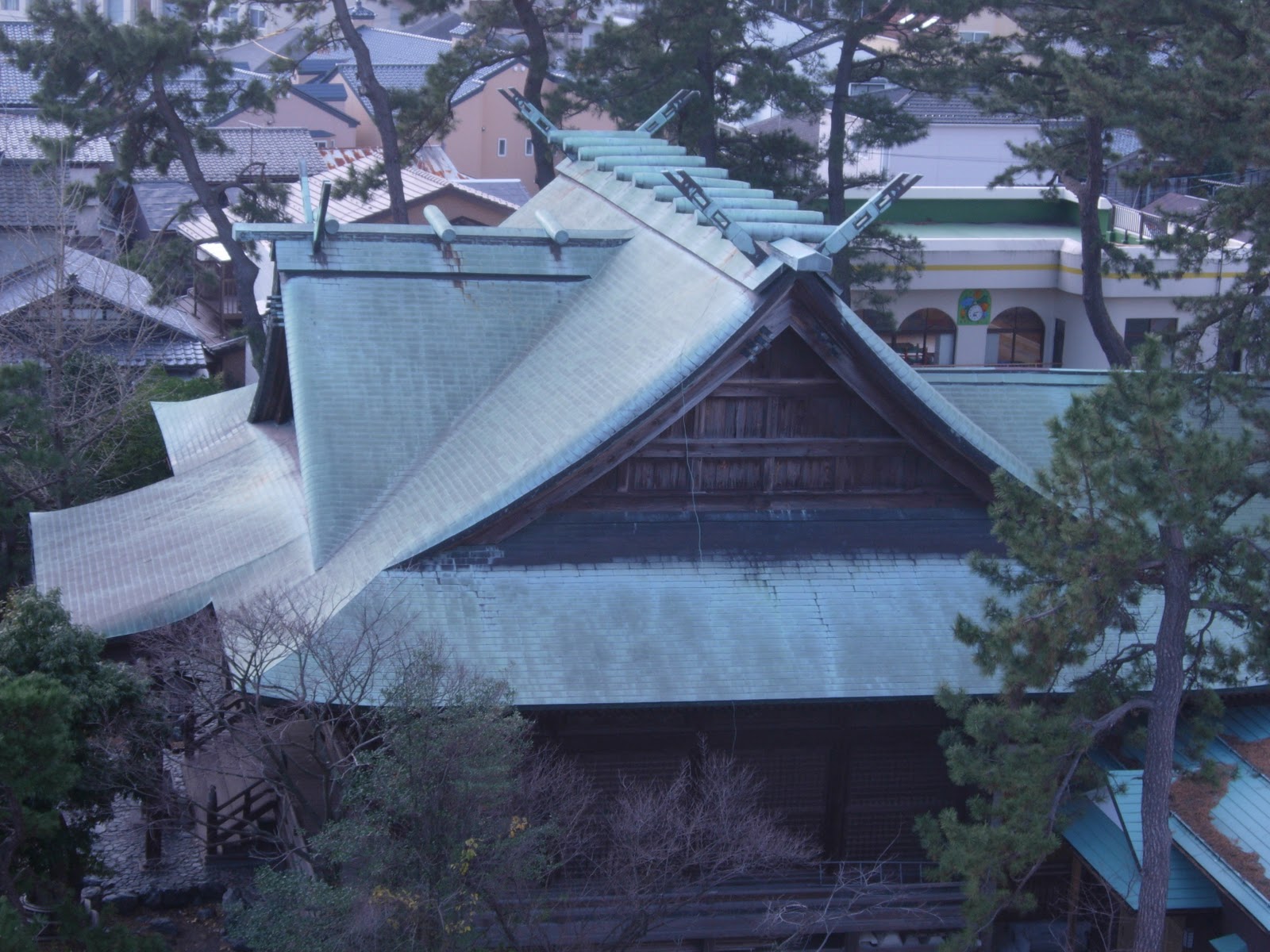


 Gohei are the sacred cuttings of folded white paper attached to the shimenawa. Note that the gohei alternate with the pendent tufts of straw. As with the shimenawa, I refer to the erudite Lafcadio Hearn for more on the subject: "The origin of the paper cuttings (gohei) ... is likewise to be found in the legend of the Sun-goddess; but the gohei also represent offerings of cloth anciently made to the gods according to a custom long obsolete."
 The shimenawa is the twisted rope hung from the main gate, suspended above the holy font or the entrance to the main hall, or wrapped around sacred trees or other objects at Shinto shrines. It may be a thick, hempen plait, as in the lower photo, or a few strands of twine, as in the upper. Of the shimenawa Lafcadio Hearn has this to say:"(I)t represents the straw rope the deity Futo-tama-no-mikoto stretched behind the Sun-goddess Ama-terasu... after Ame-no.., the Heavenly-handstrength-god, had pulled her out" [of the ground]. Depending from the shimenawa are tufts of rope signifying the roots that clung to the mythical original, which was made of grass.


