Hiroshige's woodcut shows steeplejacks, or tobi, repairing a castle beside the river Toyo in present-day Aichi. Years ago one of my students at middle school decided not to continue his education, opting instead to become a steeplejack. I suggested to one of my colleagues that perhaps this wasn't a particularly wise move for the young man. The teacher's wry comment: the accomplished tobi can make as much as 1,000,000 yen in a month (approx. $11,000). By the way, the Japanese term for "black kite" (the bird) is tobi, and the two share the following Chinese character: 鳶 . Monday, March 07, 2011
Hiroshige's "Yoshida" View, with Toyokawa Bridge: #37
Hiroshige's woodcut shows steeplejacks, or tobi, repairing a castle beside the river Toyo in present-day Aichi. Years ago one of my students at middle school decided not to continue his education, opting instead to become a steeplejack. I suggested to one of my colleagues that perhaps this wasn't a particularly wise move for the young man. The teacher's wry comment: the accomplished tobi can make as much as 1,000,000 yen in a month (approx. $11,000). By the way, the Japanese term for "black kite" (the bird) is tobi, and the two share the following Chinese character: 鳶 . On the Tokai Road Again: Hiroshige's Woodcut Series, # 38
Hiroshige's print shows a view of Edo-era Goyu, a neighborhood in present-day Toyokawa City, Aichi prefecture. The man seated at right has a tub for bathing the feet and appears to be directing the attendant's attention to a particularly bothersome blister, no doubt caused by the chafing of his straw sandals, or waraji. The lower photos show views of the area today.
Sunday, March 06, 2011
Japanese Minister Quits over Donations
Seiji Maehara announced on March 6 his resignation as Japan's Foreign Minister. Maehara bowed to pressure that he quit after it was discovered his political funds committee had accepted donations from a Korean permanent resident over a period of five years. (Japanese law prohibits political donations from non-citizens and corporations that are 51% foreign-owned.) How much did Maehara receive from the Korean friend whose restaurant the former often visited when a schoolboy? Brace yourself: 250,000 yen, or approximately 3,000 American dollars. What would the US Chambers of Congress look like if foreign persons, corporations, and governments were forbidden to buy US politicians?
Tuesday, March 01, 2011
Supreme Injustice
The US is stuck with this supreme court criminal until he croaks. In Japan most supreme court justices are over 60 when appointed and must retire at age 70. And, in Japan court justices are subjected to a people's review and can be recalled by popular demand.
Monday, February 14, 2011
The Sumo Match-fixing Scandal
The Japan Sumo Association is embroiled in the worst scandal in the history of the national sport. Evidence obtained from wrestlers' cell phones during an unrelated investigation into illegal gambling revealed the not-illegal, but certainly unsportsmanlike, practice of match-fixing among a number of wreslers just below sumo's upper division. The term yaocho refers to this practice, and the word has an interesting derivation. It seems there was a greengrocer, one Chobe, who lived during the Meiji Era. Now the Japanese for "greengrocer" is yaoya, and as Chobe was the tencho, or manager, of his shop, he went by the appellation yaocho. Chobe was an avid and accomplished player of the Japanese game of go, and a frequent visitor to his shop was a former sumo wrestler who fancied the game himself. Rather than risk offending this customer and losing the man's custom, Chobe, the superior player of the two, would allow his opponent to win. And this is how throwing a sumo bout came to be called yaocho.
Thursday, January 20, 2011
The "Thrice" Sedge Hat
Sando means "three times," "thrice". So why is this mushroom-shaped hat called the sando kasa? In the Edo Era (1603-1868), Osaka merchants established a courier service connecting Edo, Kyoto, and Osaka. Letters and parcels were sent three times a month, on the 2nd, 12th, and 22nd, and were delivered by "postmen" wearing hats like the one above. In this way the hat came to be known as the "thrice sedge hat". The sando kasa became widely adopted for the protection it offered against rain and sun, shielding the heads of travelers and farm laborers as well as the postmens' pates.
Monday, January 10, 2011
A Service Announcement
Most online shops retailing Japanese products sell items of inferior quality, if made in Japan at all. Japanese lacquer-coated chopsticks for only $2.95 a pair? Buy several, because you'll find the lacquer gone after only a few meals. Premium green tea for just $9.95. That's a half-brewed idea; the truly good stuff goes for a bit more.
If you can tell me approximately what you want and, more importantly, how much you want to spend, I can find the item for you. The product you desire at the quality you deserve. Guaranteed.
Drop me a line at japanglimpsed@yahoo.com.
Brian S.
If you can tell me approximately what you want and, more importantly, how much you want to spend, I can find the item for you. The product you desire at the quality you deserve. Guaranteed.
Drop me a line at japanglimpsed@yahoo.com.
Brian S.
Wednesday, January 05, 2011
A "Sumiyoshi" Shrine
Osaka City's Sumiyoshi Taisha shrine complex contains a nice example of the sumiyoshi style. Note the crossed beams (chigi) at the ends of the roof and those perpendicular to the ridge, called katsuoki, the latter deriving their name from the Japanese word katsuo, meaning "bonito".
A "Nagare-tsukuri" Shrine
Most of the shrines in Japan are built in the "Nagare-tsukuri" style. The distinctive feature of such shrines is the uneven length of the two roof sections, the front being somewhat longer than the rear.
Minehonsha, situated atop Mt. Oyama (3003 m) in Toyama Prefecture, is an example of the nagare style.

Minehonsha, situated atop Mt. Oyama (3003 m) in Toyama Prefecture, is an example of the nagare style.

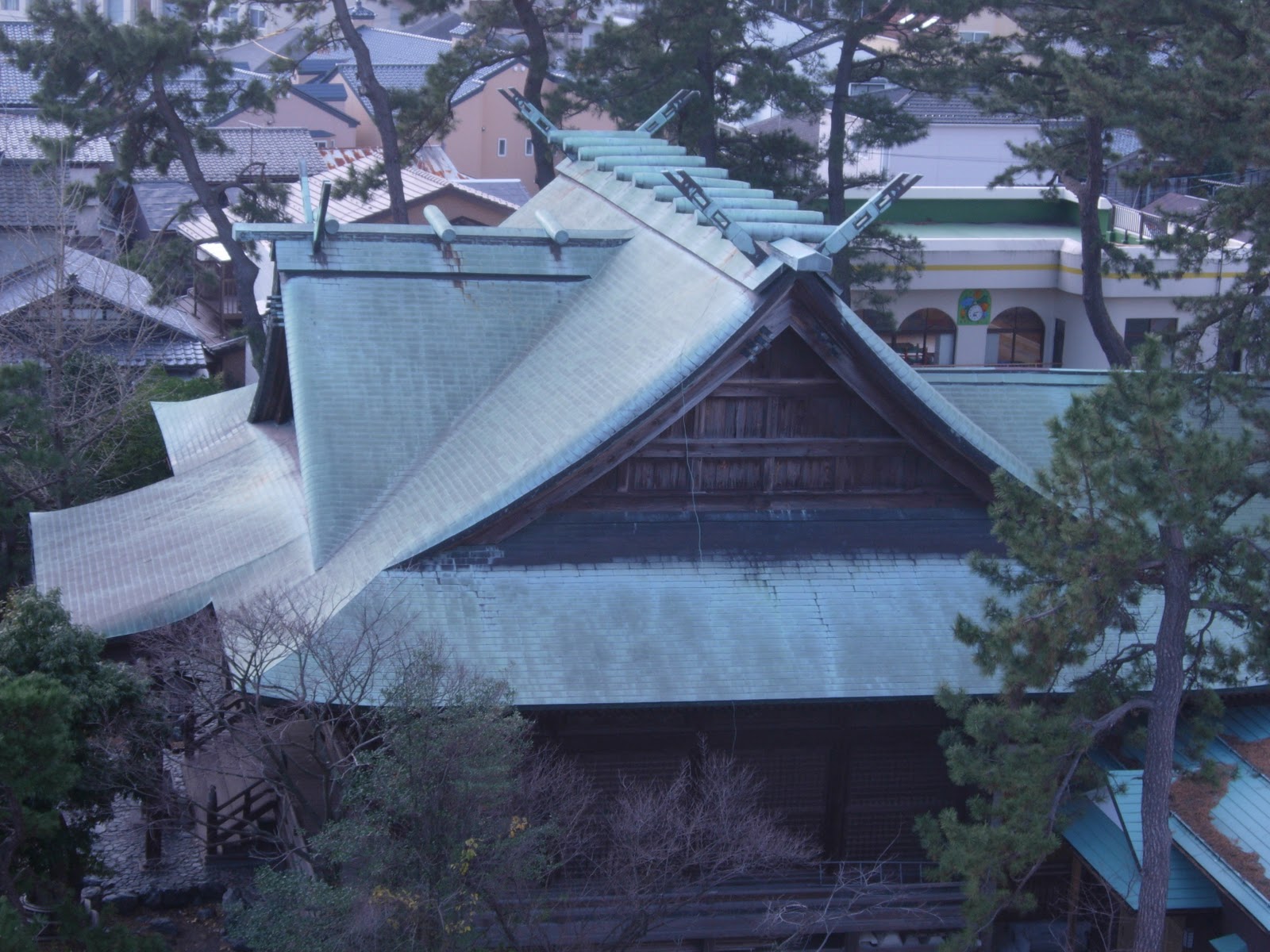
A "Hie-zukuri" Shrine
Check out the curves of the Niigata Great Shrine, located across the street from my house in downtown Niigata City. The shrine is a fine example of the "Hie" style of Shinto architecture.
Monday, November 22, 2010
Japanese Shrines: You've Seen One, But You Haven't Seen Them All
Shinto shrines may look alike, but there are numerous architectural styles. The above is the main hall at Izumo Oyashiro in Shimane, a famous example of the Taisha Style.
Sunday, November 14, 2010
More Fall in the City
The former residence of a wealthy family of importers, the house and gardens date from the 1920s and are now the property of Niigata City and open to the public.
Fall in the City
cherry trees (さくら) showing their fall color at a local park
Japanese ginko, with storehouse (kura) in the lower photo
Tuesday, October 19, 2010
Friday, September 24, 2010
Japanese Clogs # 2: Nomeri Geta
These shoes incline forward, towards the toe, and are named accordingly. What is the merit of this arrangement? I confess that I haven't the slightest, as they say. I shall ask my mother-in-law, an expert on such matters, about these geta. But in the meantime, let's enjoy the clogs' nice curves.
Monday, September 20, 2010
Japanese Clogs, or Geta
The traditional Japanese footwear is the wooden clog, called geta. Several styles are available, so the following posts will introduce the visitor to the world of Japanese shoes.
Thursday, September 09, 2010
More Bits and Pieces: The Jizaikage
The jizaikage is the pot hanger from which a kettle or cooking pot is suspended above the brazier (irori) in traditional Japanese homes.
Subscribe to:
Posts (Atom)