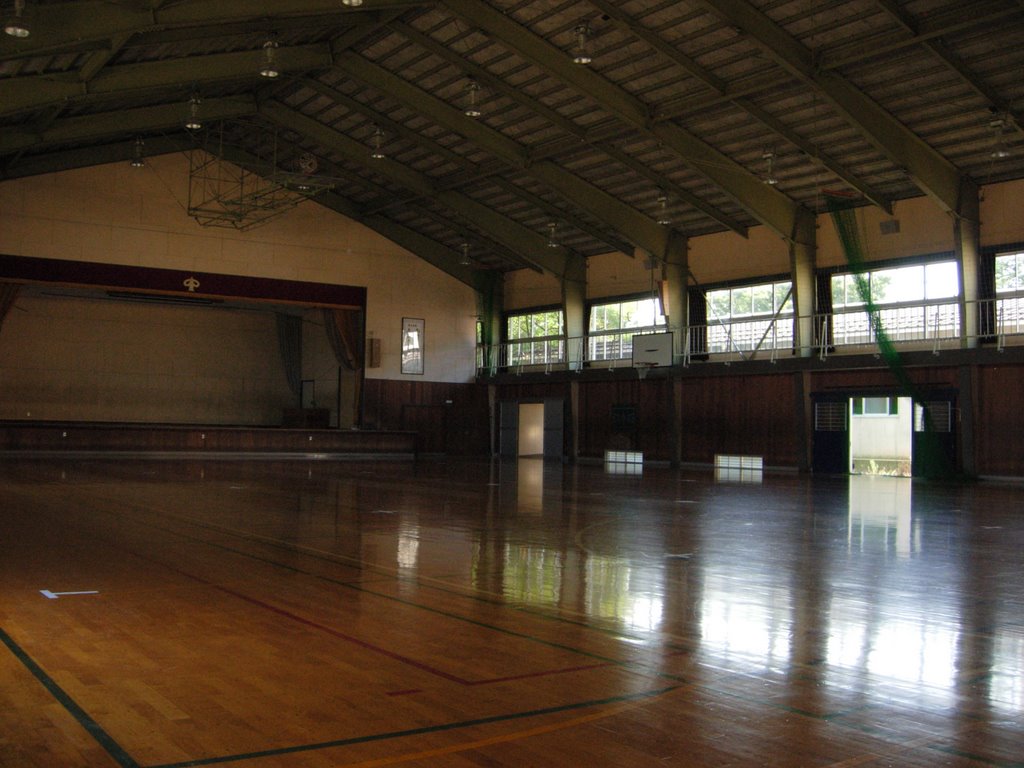
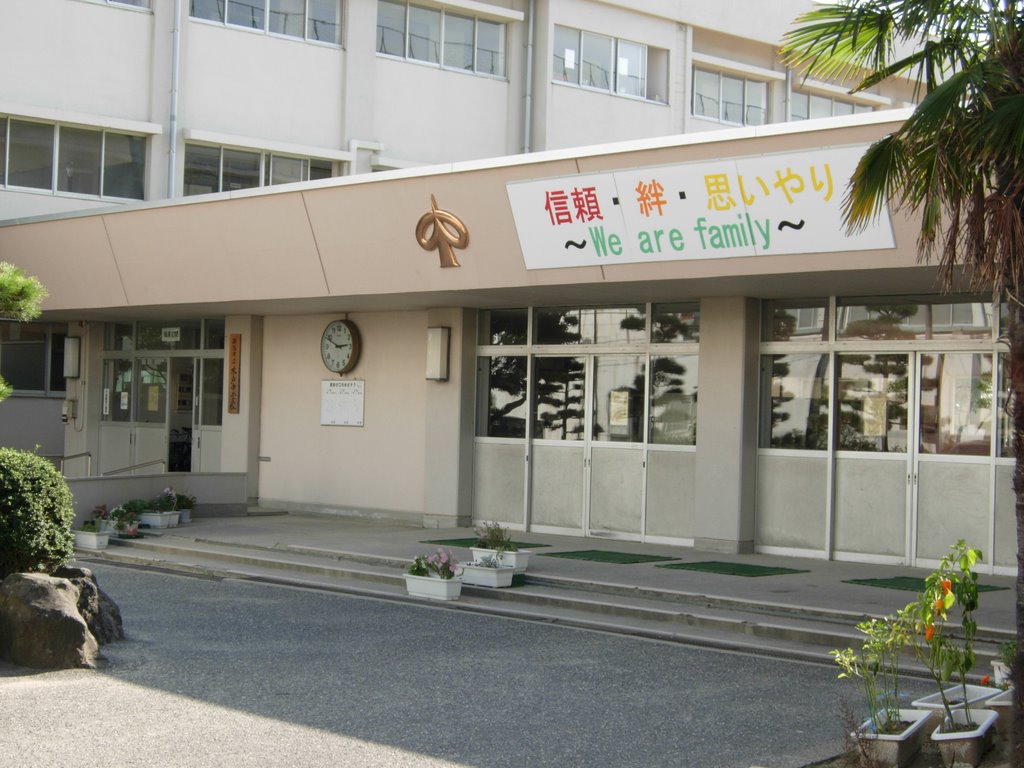
The Ohata Young People's Center is housed in the building formerly occupied by the Ohata Elementary School. Declining enrollment forced the school to close nearly 20 years ago, and its remaining students were moved to nearby Niigata Elementary School, less than a quarter- mile away. You might wonder why, for the better part of a century, the city should have needed to maintain two primary schools in such proximity. The following explanation is based on what I have gleaned from local residents. The two schools are located in what was formerly referred to as the "Beverly Hills" of Niigata City. The official residence of the prefectural governor is across the street from Niigata Elementary School, and those of his lieutenant and of the city's mayor were, until fairly recently, but a short distance away. Influential private citizens made their homes in the neighborhood as well, and these were joined by a small expatriate community. Niigata's entertainment quarter was (and is) nearby, and geisha were a common sight in the neighborhood. So, too, were their "illegitimate" children, who were nevertheless legally required and entitled to six years of primary school education. Our pillars of the community, who sent their offspring to Niigata Elementary School, objected to this morally contaminating influence- and were perhaps apprehensive lest certain of the urchins be mistaken for their own. Suffice it to say that these influential citizens succeeded in persuading the Board of Education to establish a school for the exclusive use of the geishas' children, and that the Ohata Elementary School continued to operate long after the kimono was replaced by the mini-skirt.
Sunday, April 15, 2007
Friday, April 06, 2007
Heaven and Hell Lane
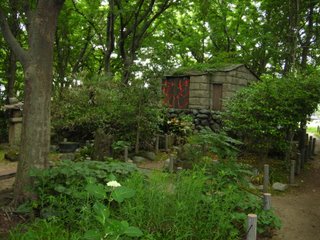
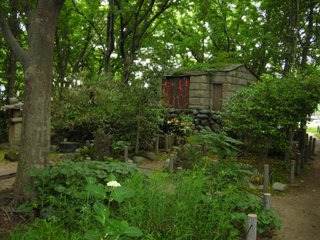
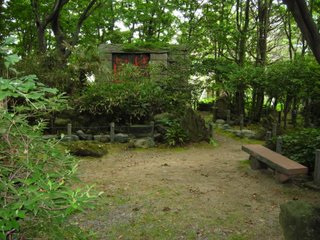
The topmost photo shows the narrow street known locally as "Heaven and Hell Lane" in Niigata City. Whence this curious appellation? Let us begin with the culinary paradise that is Ikinaritei, one of whose exterior walls is visible at left. The restaurant dates to the Edo era, and the lovely wooden structures housing its several dining rooms, as well as their sylvan setting, have been designated a National Treasure by the central government. Though first-time patrons no longer must present letters of introduction from prominent citizens before being allowed through the gates of Ikinaritei's holy precincts, they must still take fistfuls of yen with them, for with lunch a relative bargain at ¥7,000, a full-course Japanese dinner starts at ¥33,000- $350 at the current exchange. This, then, is the "Heaven" to which only the "elect" were formerly admitted. On the opposite, or "Hell", side of the street, was the City Prison. All that remains of the former house of incarceration, which was moved to a new location on the outskirts of town about 20 years ago, are a commemorative plaque or two and a section of the original brick wall, the latter visible in the middle ground of the topmost photo. The vicinity is sometimes referred to as the "Beverly Hills" of Niigata-consider therefore the curious juxtaposition of a detention facility and the homes of local worthies. The grounds of the former prison are now the lovely Nishi Ohata Park.


Monday, April 02, 2007
An Early Loan Shark
The Niigata City Branch of the Northern Culture Museum pays tribute to the contributions to local history made by the Ito family,whose exploits date to the Meiji Era. The Itos began as modest landlords in the late 19th century, but by the 1920's they owned 3300 acres, one of the largest feudal fiefdoms in all of Japan. This they accomplished by extending loans to impoverished peasants and seizing their land in the event of default. The dispossessed peasants became tenants on their former property. At one time as many as nine hundred farming families, comprising 60 small communities, worked lands controlled by the Itos. After Japan's defeat in WWII, the U.S. Occupation confiscated all such estates and embarked on an ambitious land redistribution scheme. The Ito mansion, located a few kilometers outside present-day Niigata City, became the Main Branch of the Northern Culture Museum, while the Itos vast landholdings were parceled out to small farmers in the area. The family would appear to be in general decline, for the direct male line ended a generation ago, the current Mr. Ito being an adoptee. There is a Master Ito, however, a little brat with whom my son has the misfortune to be an elementary school classmate.
Saturday, March 17, 2007
The Rice Cake Fair
Every year in March, the students of Niigata Elementary School and their parents participate in the Rice Cake Fair. Mochi, or rice cakes, are made from a special variety of rice. The rice is first boiled, and the cooked rice is then placed in a large wooden mortar, the usu. The rice is subsequently pounded with a massive wooden pestle, the kine. When the rice becomes a heavy, glutinous mass, it is ready to enjoy. The school provided bean jam and soybean flour as toppings, and the children and adults speedily devoured what had taken considerable time and effort to produce. Mochi is commercially prepared by machine, the traditional laborious method being used only at festivals. Rice cakes are eaten year round but figure prominently at New Year's, when they are both consumed and used as decorations. The kagami mochi is a traditional mochi decoration as well as offering to the gods, and it consists of two or three rice cakes placed one atop the other. Though our own benighted age permits all manner of regrettable lapses, traditional usage stipulated that kagami mochi be displayed beginning December 28th. This was due to superstitious beliefs regarding auspicious dates for display, the nearest to January 1st being the 28th of the preceding month. Needless to say, such practices have long since fallen into disuse in this decadent era. When they are not being employed for sacred purposes, kagami mochi of plastic construction may be put to uses sartorial. Rice cakes are sometimes offered by shrines as New Year's gifts to visitors, a custom discontinued at Niigata's Yahiko Shrine after a stampede claimed 124 lives on Jaunuary 1st, 1956.
Sunday, March 11, 2007
And The Winners Are...
Monday, March 12, is the date of the anouncement of public high school entrance exam results this year. It is now shortly before 3:00 in the afternoon, and the atmosphere in the teachers' room is tensely expectant as third grade homeroom teachers and the school administration await the fateful ringing of the phone. The high schools post exam results on large notice boards at the school entrance, and the students attempting to enter the school nervously scan the boards for their registration number, hoping they are numbered among the elect. The students are joined by a teacher from their middle school who relays the results to the school itself by phone. Even as I write, the phone rings bringing additional announcements. The students who pass the exam remain at the school for a packet containing information about the upcoming school year. Those who fail the test return to their middle school later in the afternoon to confer with their homeroom teacher regarding Plan B. The latter generally involves sitting the entrance exam the following day at one of the private high schools in the area. Students whose parents cannot afford the exorbitant tuition and fees of private schools may take the "second chance" exam, held March 26, at one of the less desirable public high schools, for at this late stage they are the only ones with vacancies remaining.
Thursday, March 08, 2007
The Junior High School Graduation Ceremony
There is a ceremony for nearly every occasion at Japanese public schools. The school year begins in early April with the entrance ceremony for incoming first-year students. Scheduled for the following day is the ceremony inaugurating the new school year. Not to discriminate, the first and last days of each term throughout the year are similarly granted their own special notice. Another ceremony, that welcoming new teachers to a school, is held at the beginning of the year and throughout the year when necessary. Niigata City ALTs change schools three times a year and are therefore welcomed at their second and third term placements in what is effectively a private ceremony. The farewell ceremony for teachers is held at the end of the school year. The public servant transfer system accounts for most departures. Under this system, public school teachers are sent to two schools during their first six years, often in isolated or rural areas. If the teacher survives six years in the sticks, he is rewarded with a seven year posting at a school administered by the city in which he hopes to reside. Every seven years thereafter the teacher is transferred to a different school. Finally, Japanese schools celebrate the major anniversaries of their founding, with commemorative aerial photos taken of the students arrayed on the playground in the form of the school logo. These ceremonies are observed with varying degrees of pomp and circumstance. The super heavyweight event of them all, that boasting the greatest endowment of the two aforementioned qualities, is the Graduation Ceremony. The ceremony is formally opened with an official declaration, followed by the singing of the controversial national anthem, the Kimigayo, as well as the school's own song. The graduating students are then called to the stage by homeroom class to receive their diplomas from the principal. Speeches exhorting the graduates to perseverance and excellence are made by the principal and PTA president, the addresses often including references to Ichiro Suzuki and Hideki Matsui, successful Japanese baseballers in the U.S. Major Leagues. The speeches are followed by choral performances by the entire student body. The accompanying photos show the school entrance and gymnasium decorated for graduation on March 7.
Saturday, March 03, 2007
Standoff at Kisaki, Round II
The harassed tenants who persisted in defying the government and its local representative, education superintendent Majima Keijiro, removed their children from public schools. They subsequently established their own schools, further rousing the ire of the authorities. The latter employed forceful measures to counter the tenants, and many activists were detained by the constabulary.
Contemporaneously, the national tenants' union underwent a period of debilitating internal dissension, further isolating the tenant farmers in Kisaki. After a protracted eight year struggle, the tenants were finally defeated in 1930. By this time, the only school remaining for tenants' children was a post-elementary institution, the others having been closed years before. The photos show the public elementary and middle schools in Kisaki.
Note: Historian Mikiso Hane's Peasants, Rebels, & Outcastes: The Underside of Modern Japan is the source of the preceding information, which I have loosely paraphrased.
Friday, February 23, 2007
Standoff at Kisaki
Kisaki, a small community in Toyosaka City, lies twenty kilometers east of central Niigata. Some eighty years ago it was the scene of a bitter and protracted feud between tenant farmers, landlords, and a particularly intransigent superintendent of local schools, Majima Keijiro.
Having formed a union in the early 1920s, the local tenant farmers sought to negotiate a 20% reduction in their rents. To this demand the landlords acceded, but they were overruled by the head of their association, one Majima Keijiro. The tenants responded by refusing to pay any tax at all, whereupon Majima received a court order prohibiting the tenants from working their land. Taking personal responsibility for the failure of the tenants' cause, the union leader committed suicide, and nearly half of the farmers capitulated. Mr. Majima wasn't satisfied, however, for he then demanded that the recalcitrants be evicted and made to pay all taxes they owed.
The bailiff dispatched to execute the court's order was nearly despatched himself, and clashes between police and farmers ensued, resulting in numerous arrests. Majima was superintendent of schools, in addition to being an influential landlord, and the tenants retaliated by removing their children, some 600 all told, from public schools. They then established separate schools to educate their children, the first time such a development had occured in Japan.
Sunday, February 11, 2007
James Porcaro: Time to end the use of ALTs
Mr James Porcaro is an associate professor of English as a foreign language at the Toyama University of International Studies, as well as "special" to the Daily Yomiuri. In a recent edition of the aforementioned paper, Porcaro impugns the integrity of the systems whereby native English speakers are employed by the Ministry of Education, as well as municipal boards of education, to assist Japanese teachers of English in junior and senior high school English classes. Does this obscure pedagogue possess indisputable evidence to support his vitriolic assertion that the ALT program is "a wasteful expenditure of massive funds"? Hardly, for as the author of "Time to end the use of ALTs" himself admits, "There seem to be no comprehensive studies with valid empirical evidence to show that the presence of ALTs...has effected any notable advance in students' English language proficiency..." Nonetheless, in the crucible of Porcaro's disordered brain this is proof positive that ALTs are a waste of taxpayer money. As for studies demonstrating the opposite, namely that ALTs are wholly without educational value, Porcaro is curiously reticent concerning them. Should we anticipate a forthcoming magnum opus on the very subject from this towering intellect of the provinces? Is this article, which initially managed to appear in a newsletter published by the Japan Association of Language Teachers, merely the abstract, as it were? On what foundation, then, do the spurious claims of our "special" correspondent rest? Well, he has a few anecdotes, he has perused the musings of a former ALT, and he has observed the lessons of "about 20 ALTs...over the past two decades". In twenty years James Porcaro has observed as many ALTs, and yet he feels this superficial contact authorizes him to make sweeping characterizations that apply to the many thousands of ALTs who have successfully assisted public English education in this country during the same period? Most scientific indeed, this process of induction, but not unsurprising from an academic who in two decades has yet to publish anything of merit, scholarly or otherwise. I invite you, James Porcaro, to visit Niigata City and to observe the English lessons of the outstanding ALTs employed by the city Board of Education. You could then claim to have observed about thirty ALTs during the last twenty years, and you could reap the benefits of an addition to your meager fund of empirical knowledge. Furthermore, to offset the testimony of "scores of JTEs [Japanese Teachers of English}" whom you allege to have disparaged ALTs, I should be happy to introduce you to scores of Niigata JTEs who greatly value our contributions and expertise. So great is their appreciation, in fact, that in many cases the JTEs request of the BOE that a particular ALT return to the same junior high school the following year. Furthermore, I should like you to meet the many students who have attended our popular summer English Camp, as well as those who have been motivated and inspired by us to experience an overseas homestay. There are countless others, currently enrolled in intensive English programs at high school or pursuing a university degree in the language, who someday hope to enter a profession requiring advanced English proficiency. We ALTs reasonably claim some credit for this. Before committing yourself to print on some future occasion, James Porcaro, I suggest you research your subject a trifle more thoroughly. In the present instance it is painfully obvious that you know next to nothing about ALTs and the valuable work they do.
Japan's Second Minamata Outbreak
Note: On March 13, 2007, two male residents of Niigata City were added to the number of those afflicted with Minamata Disease.
The pictures show the lower reaches of the Agano River, which empties into the Sea of Japan in eastern Niigata City. The headwaters of the Agano are rise in neighboring Fukushima, and the mountains along the prefectural boundary are faintly visible in the photo at center. Forty years ago few would have dared fish here, for the Agano was the scene of Japan's Second Minamata Disease outbreak. The world's first documented case of methyl mercury poisoning of humans through foodchain contamination had occurred years earlier in Kumamoto, a prefecture on the southern island of Kyushu. In that case, the Chisso Corporation was dumping contaminated wastewater into nearby waterways, resulting in the poisoning of fish and shellfish in Minamata Bay. Local inhabitants who consumed contaminated marine products later contracted the terrible neurological disorder that came to be known as Minamata Disease. Due in large part to the heroic efforts of photojournalist W.E. Smith, who moved to the area with his Japanese wife in order to document the tragedy, Minamata sufferers received an outpouring of sympathy from around the world. Smith himself was savagely beaten by thugs in the hire of Chisso, temporarily losing his hearing and suffering declining health thereafter.
The Showa Denko Chemical Corporation was the source of Niigata's Minamata outbreak. Located forty miles upstream from the mouth of the Agano, in Kanose Town, the chemical plant dumped polluted, untreated wastewater directly into the river. As had happened in Kyushu nearly a decade earlier, locals began to notice large fish kills, and stray cats showed symptoms of a strange distemper. Eventually, the inhabitants of downstream communities developed the classic symptoms of mercury poisoning, and doctors at Niigata University's Medical School promptly diagnosed Minamata Disease. Medical researchers from Kumamoto University were summoned to lend their expertise and experience, and Showa was quickly identified as the source of the pollution. Mirroring the Chisso Corporation's response, executives at Showa were uncooperative, even suggesting that the massive earthquake to hit Niigata City the previous year was somehow responsible for the outbreak, this despite full knowledge that its wastewater was highly toxic, being the effluent of a manufacturing process almost identical to that employed by Chisso. Obstruction and obfuscation were of no avail, however, but that must offer little consolation to the 690 victims of Showa's criminal negligence. I am unaware whether the executives of either corporation spent any time in prison, surely the only suitable place for them to complete the term of their wretched existence. Wikipedia is an oustanding source of comprehensive information about Minamata Disease.
Tuesday, January 30, 2007
More New Year's Customs and Curiosities


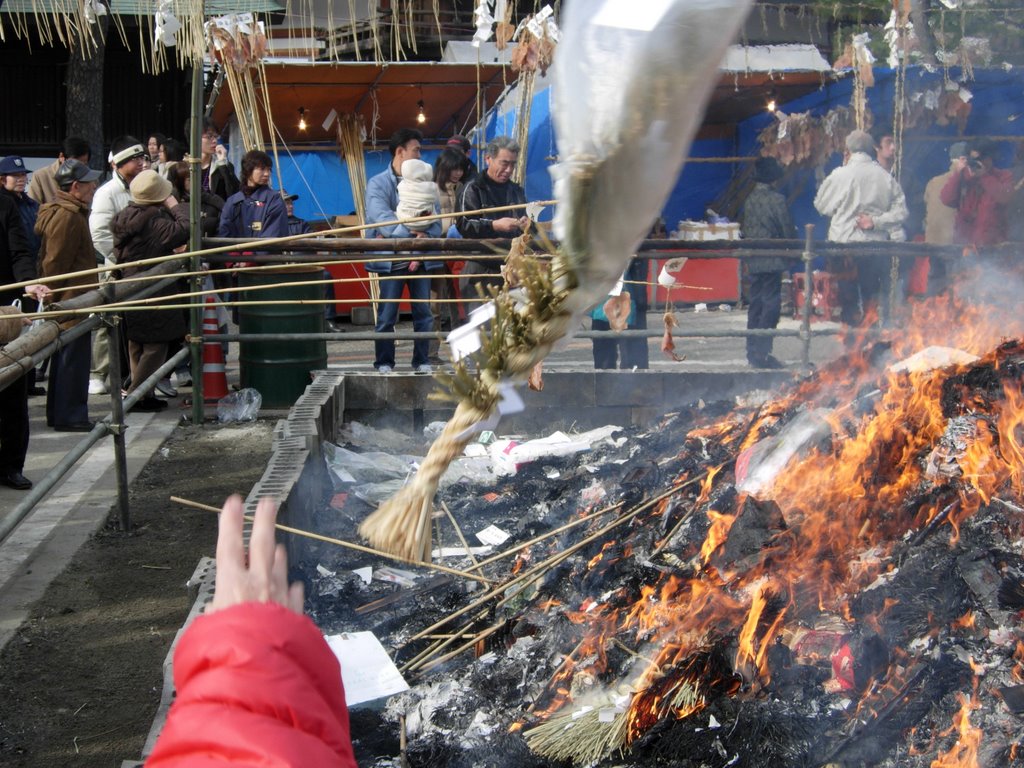
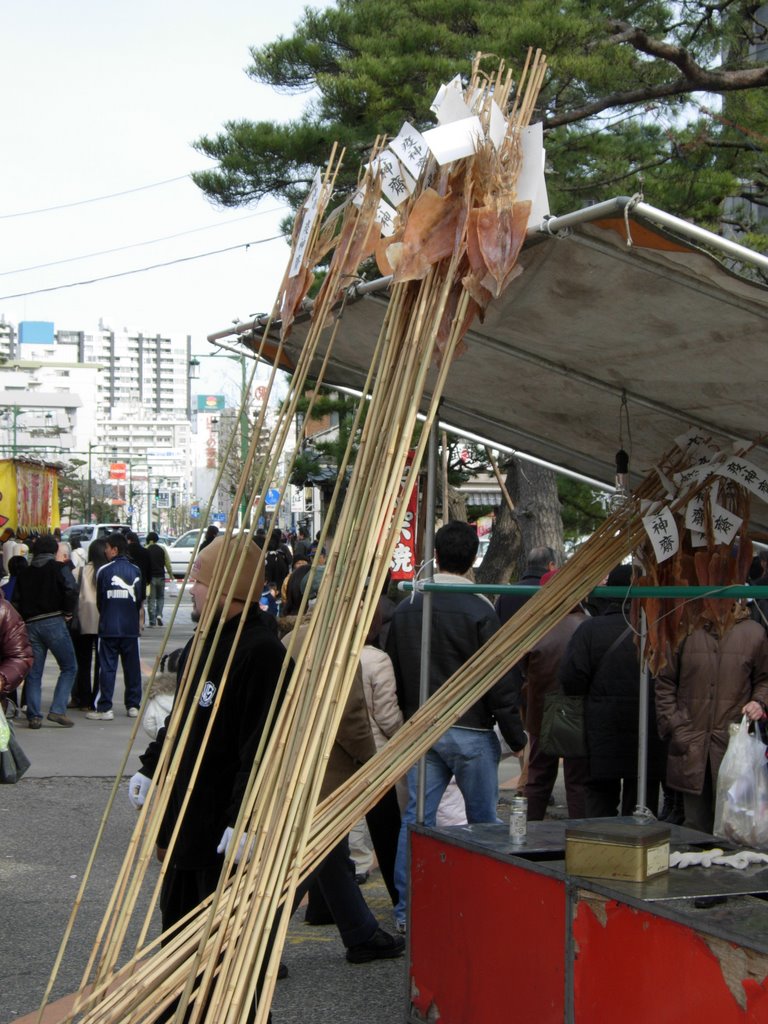
The photos were taken at Niigata City's most prominent shrine, Hakusan, on January 1st of this year. The Japanese regard the New Year as an opportunity to begin anew, to rededicate themselves to pursuits professional, educational, or commercial, and to invoke the gods' blessing on these, as well as on their friends and family. The passing of the old year and commencement of the new calls for a fresh slate on which to record the coming year's achievements. The Japanese bid farewell to the past year at end-of-the-year parties known as bo-nen kai, or the "forget-the-year gatherings." On New Year's Day, Japanese visit their shrine of choice to pray for health and good fortune, as well as to consign to the flames such objects as ema, shimekazari, wajime, daruma, and other mementoes of the preceding year. Now the ema is a small wooden plaque, approximately rectangular in shape and 3x5" in dimension. Ema can be purchased from most larger shrines, and bear on their upper surface the supplicant's handwritten prayer. The ema is then hung on a lattice frame or attached to a board near the entrance to the shrine's main hall. The shimekazari is the decorative form of the shimenawa and is hung above house doors at New Year's and, more commonly, the small family shrine, the shinzen or butsudan, kept in Japanese homes for the purpose of honoring one's ancestors. The wajime is a decorative straw wreath hung on the front doors of houses and some businesses, as well as the occasional automobile grille. The daruma is a pear-shaped red doll with one eye-socket blank, the other almost completely filled by its black pupil. Daruma are purchased by individuals or organizations at the start of an arduous campaign, whether political, athletic, or business-related. Should the endeavor prove successful, the doll's other eye is painted in out of gratitude. All of the above are placed on the pyre and replacements purchased. Not only is the fire a welcome source of warmth on a cold New Year's Day, but it is ideal for roasting surume-ika, or dried, salted cuttlefish, on the end of a ten-foot bamboo pole. Just why this delicacy is consumed at New Year's is a mystery to me, but certain it is that the local yakuza who operate the food stalls at this and other festivals profit handsomely from the sale of each 1000 yen ($8) "squid-on-a-stick." Another seasonal treat is roasted chestnuts, or kuri. According to no less an authority than Lafcadio Hearn, kachi-guri (as they are also known) are popular because the kachi of the name is homophonic with another kachi, that meaning "victory." What with monetary and other donations, as well as receipts from the sale of charms and related accessories, shrines such as Hakusan post a healthy profit at the end of the busy New Year's celebration.
Thursday, January 18, 2007
Exam Madness
As regular as the movements of the fixed stars in their orbits is the annual recurrence of the two- month period known in Japan as Exam Hell. No one particularly enjoys this cruellest season, other than the bursars of the private educational institutions that profit handsomely from this madness, and the cram schools that strive mightily to squeeze a few additional fistfuls of yen from anxious parents. But it remains, even in the dawn of this enlightened 21st century, a rite of passage, a trial to be endured. Though I have resided in Japan for the better part of a decade, I have only recently been granted a glimpse of the holy of holies, the inner sanctum, the vital organs, as it were, of the Japanese business of entrance-exam-based education. Let us now anatomize a few of the systems that permit this structure to perpetuate its anachronistic existence.
In Niigata City, the two month period of Entrance Exam Madness commences in mid-January. By November or December of their final year, junior high school seniors should have chosen the high school, public or private, that they hope to attend. For unlike their previous experience of school enrollment, which was mandatory and determined by moderately flexible attendance zones, enrollment at high school is optional, as well as highly competitive. That is, one could attend a prestigious public elementary or middle school simply on the basis of his address. But with the stakes now much, much higher, it behooves ambitious students (as well as their parents) in their final year of junior high to perform a sort of dervish dance of cram school cramming, interspersed with occasional visits (and monetary donations) to shrines promising entrance exam success, further seasoned, when affordable, with expensive (but, Guaranteed to produce results!) visits by the home tutor, or 家庭教師.
For a fortunate few, the suisen, or recommendation, system permits middle schoolers of pronounced athletic, academic, or artistic ability to pass "Go", as it were, with, for the truly exceptional, the added opportunity to collect $200 as well. For those mere mortals who know their own minds, at least, there is the sengan process, whereby the student places all of his eggs in a single high school basket, and proceeds to watch it. Alternatively, students who would prefer to attend a public high school (admission to the best of which is highly selective and competitive), but who are perhaps less than sanguine about their chances, are well-advised to sit the heigan, or general- admission, exam at a private high school. Having passed the general- admission exam, the student can concentrate his attention on the public- school counterpart, at the same time experiencing a drop in pressure (and motivation?) from knowing that a stand-by is available should he bomb the upcoming test. The entrance exam for public high schools is held the day after the junior high school graduation ceremony. Students sit the exam at the high school they hope to attend, and results are announced within a day or two. Those students who fail but have a private- school option experience only disappointment. Students who have no such option experience some considerable anxiety as well, for their choices are limited to those schools, public as well as private, that have openings remaining. Such students must take the "second-chance" exam, held a few days after the public-school results are anounced.
That such a complex and drawn-out system invites manipulation by private schools should come as no surprise, though the reader may well be shocked by the degree to which this occurs, as illustrated by the following.
Meikun is the prefecture's most popular, as well as prestigious, private high school. Indeed, so many are the applicants each year that the school nearly fills its available slots through the aforementioned sengan system. Nonetheless, a few positions invariably remain unfilled, and those students who are not admitted to the more elite public high schools vie for the few available openings offered through Meikun's "second-chance" exam.
To the directors of Dai-Ichi High School, whose name (Number 1) is belied by its second-class status, this presents an irresistible opportunity, for some of the students hoping for late admission to Meikun would have taken (and passed) Dai-Ichi's general admission exam, just in case their other options should come to naught. By noon of the day of Meikun's "second-chance" exam, and therfore well before the results of the test are known, Dai-Ichi requires non-refundable payment of its admission fees, totalling some $1,500. Those students who are admitted to Meikun through the back door, as it were, and who had already been accepted by Dai-Ichi, can therefore say "sayonara" to their (parents') 200,000 yen.
In Niigata City, the two month period of Entrance Exam Madness commences in mid-January. By November or December of their final year, junior high school seniors should have chosen the high school, public or private, that they hope to attend. For unlike their previous experience of school enrollment, which was mandatory and determined by moderately flexible attendance zones, enrollment at high school is optional, as well as highly competitive. That is, one could attend a prestigious public elementary or middle school simply on the basis of his address. But with the stakes now much, much higher, it behooves ambitious students (as well as their parents) in their final year of junior high to perform a sort of dervish dance of cram school cramming, interspersed with occasional visits (and monetary donations) to shrines promising entrance exam success, further seasoned, when affordable, with expensive (but, Guaranteed to produce results!) visits by the home tutor, or 家庭教師.
For a fortunate few, the suisen, or recommendation, system permits middle schoolers of pronounced athletic, academic, or artistic ability to pass "Go", as it were, with, for the truly exceptional, the added opportunity to collect $200 as well. For those mere mortals who know their own minds, at least, there is the sengan process, whereby the student places all of his eggs in a single high school basket, and proceeds to watch it. Alternatively, students who would prefer to attend a public high school (admission to the best of which is highly selective and competitive), but who are perhaps less than sanguine about their chances, are well-advised to sit the heigan, or general- admission, exam at a private high school. Having passed the general- admission exam, the student can concentrate his attention on the public- school counterpart, at the same time experiencing a drop in pressure (and motivation?) from knowing that a stand-by is available should he bomb the upcoming test. The entrance exam for public high schools is held the day after the junior high school graduation ceremony. Students sit the exam at the high school they hope to attend, and results are announced within a day or two. Those students who fail but have a private- school option experience only disappointment. Students who have no such option experience some considerable anxiety as well, for their choices are limited to those schools, public as well as private, that have openings remaining. Such students must take the "second-chance" exam, held a few days after the public-school results are anounced.
That such a complex and drawn-out system invites manipulation by private schools should come as no surprise, though the reader may well be shocked by the degree to which this occurs, as illustrated by the following.
Meikun is the prefecture's most popular, as well as prestigious, private high school. Indeed, so many are the applicants each year that the school nearly fills its available slots through the aforementioned sengan system. Nonetheless, a few positions invariably remain unfilled, and those students who are not admitted to the more elite public high schools vie for the few available openings offered through Meikun's "second-chance" exam.
To the directors of Dai-Ichi High School, whose name (Number 1) is belied by its second-class status, this presents an irresistible opportunity, for some of the students hoping for late admission to Meikun would have taken (and passed) Dai-Ichi's general admission exam, just in case their other options should come to naught. By noon of the day of Meikun's "second-chance" exam, and therfore well before the results of the test are known, Dai-Ichi requires non-refundable payment of its admission fees, totalling some $1,500. Those students who are admitted to Meikun through the back door, as it were, and who had already been accepted by Dai-Ichi, can therefore say "sayonara" to their (parents') 200,000 yen.
Saturday, January 13, 2007
The Japanese New Year


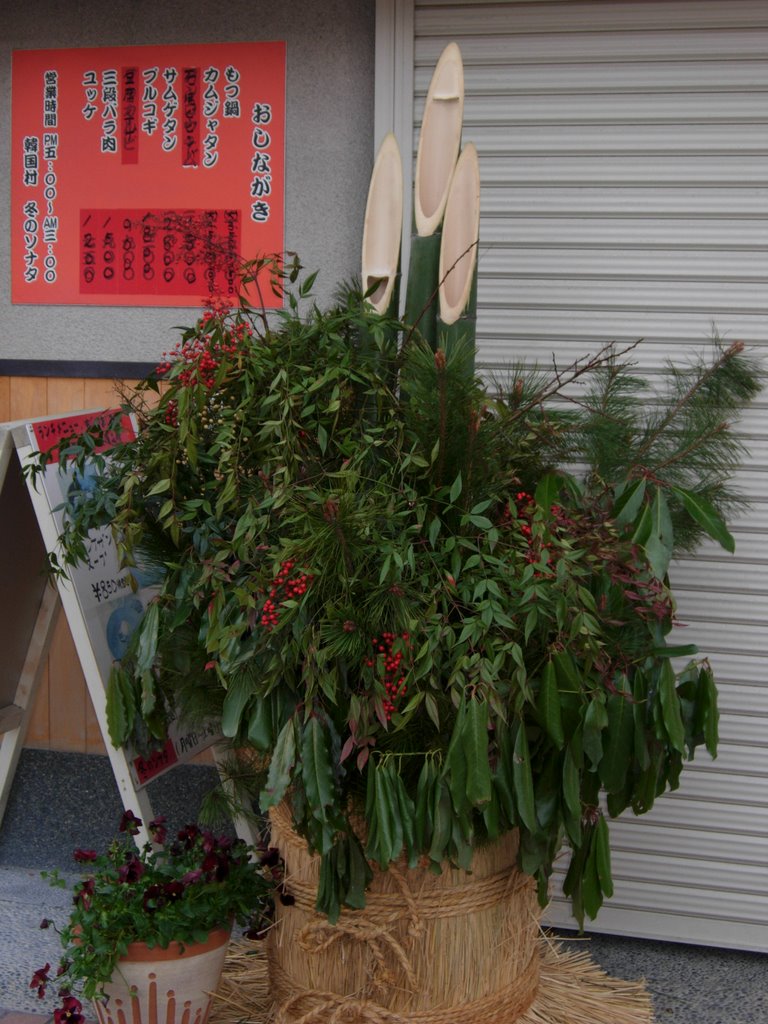
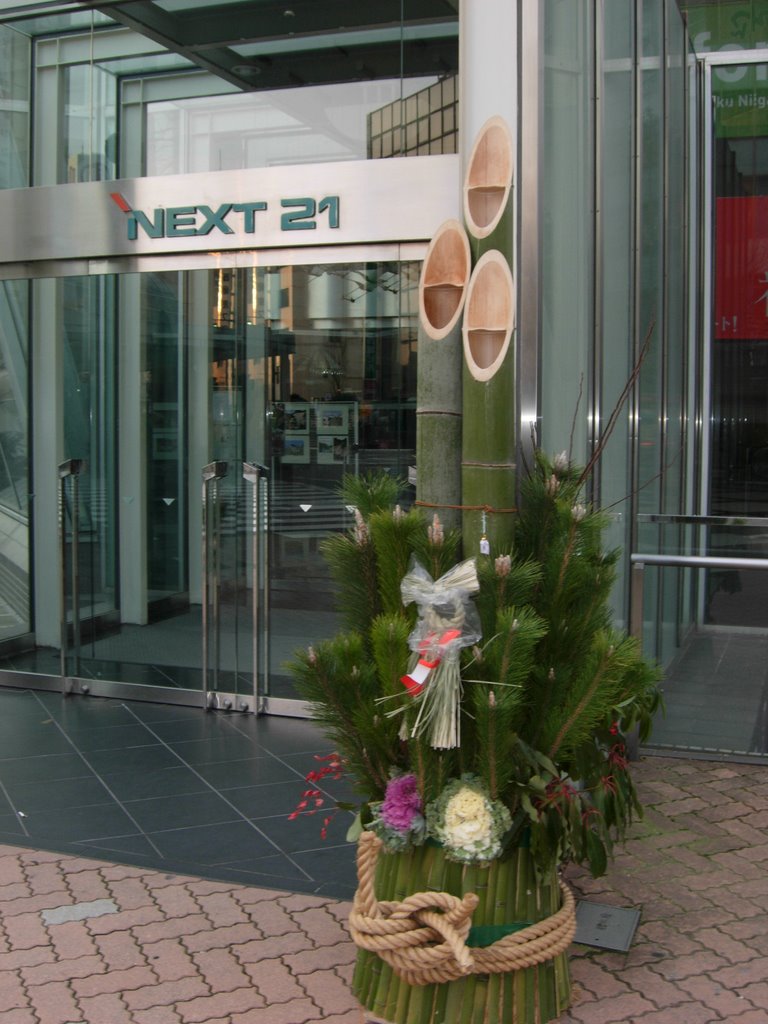
The topmost photo shows a typical New Year's decoration hanging before the street door of a private residence. The straw rope is a shimekazari, the decorative form of the emblematic shimenawa. The latter is the thick rope which hangs from the torii, or gate, at the entrance to a Shinto shrine. The shimenawa is by some believed to represent the rope, strung by the gods across the entrance to the sun-goddess Amaterasu's cave, employed to prevent her return thereto, after she had been enticed to leave her lair. Alternatively, still others aver that the shimenawa represents the rope with which the gods, having abandoned diplomacy, hauled Amaterasu from her cave by main force. In any case, the straw tufts depending from both the shimekazari and shimenawa are the "roots" that, in the legend, still clung to the leaves and stems forming the straw rope. The white paper pendents, or gohei, are said to recall the ancient custom of making offerings of cloth to the gods. The remaining photos show the traditional New Year's decoration known as the kadomatsu. The kadomatsu, or" gate-pine", is placed outside public buildings and some commercial establishments. The components of the "gate-pine" are not merely decorative but symbolic as well. The lengths of bamboo forming the kadomatsu are cut to show their joints, or nodes. These are called setsu in Japanese. But homophonic to this is another setsu, meaning "fidelity, constancy". Thus, the bamboo serves to satisfy the Japanese love of word play, as well as to symbolize a highly prized virtue. The "pine" of the kadomatsu is likewise representative. Pines are symbols of strength and tenacity, for when other sylvan species lose their foliage, evergreens such as the pine retain theirs. The glossy green leaves, of which the larger kadomatsu contains an abundance, are yuzuri-no-ha, or leaves of the yuzuri. These are emblematic of the continuation of the family line from father to son in perpetuity, inasmuch as the dying leaves of the yuzuri do not fall off before their replacements have reached maturity. The straw wreath sometimes affixed to the kadomatsu is the wajime. As well as adding to the decoration of the kadomatsu, wajime may be found on automobile grilles and the doors of small businesses and residential properties. Not pictured is the variety of bitter orange named daidai. This edible decoration, seving to garnish trays of the traditional New Year's cuisine known as osechi, provides yet another example of the Japanese penchant for puns. The character 代、pronounced dai and meaning generation (among other things), when repeated becomes "from generation to generation," hence the symbolic significance of the bitter orange, the daidai.
Monday, January 08, 2007
Mt. Haguro: The Summit

Halfway to our destination we pause, panting and perspiring, to explore a small hakaba, or graveyard, a few meters off the path. The sun, which ordinarily hestitates to peer into this twilight region shielded by towering firs and cryptomerias, has found an opening in the canopy and brilliantly illuminates the Buddhist statuary of the hakaba. The most recent of the wooden laths informs us that this plot is sacred to those who have supported the religious authorities with monetary endowments, and who have prayed for generations of Fathers Superior. The general sense of the inscription is, "The shrine undertakes to pray for those whose donations have defrayed the expenses of the shrine and enabled its operations. In the name of the current Head Priest and generations of priests before him..." A few more photos taken, and I steel myself for the final ascent.
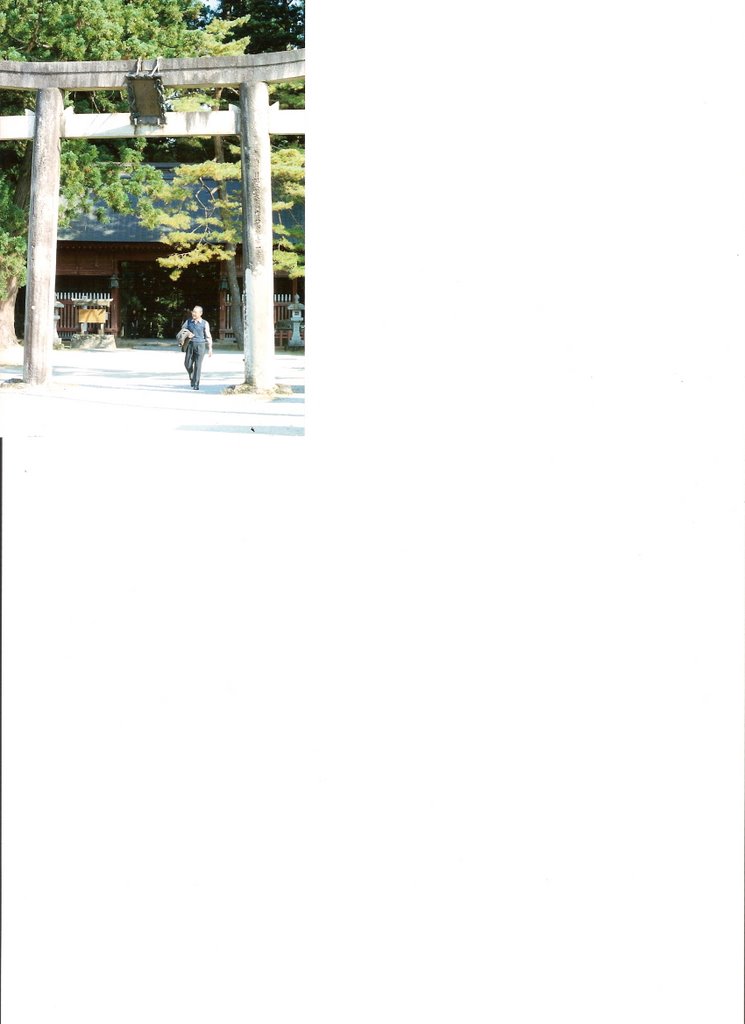
The last of the 2446 steps trod, behold the imposing shrine on the summit. Haguro enjoys a long history as a sacred mountain, a place of Shinto and Buddhist worship for over 1400 years. The present haiden, or sanctuary building, was constructed in 1816. It is exceedingly rare for such a structure to have a roof of thatch, roofing usually being of copper or tile. There is quite a crowd, both young and old, to pay respect to the mountain deities and snap "I was there!" commemorative photos. But I musn't tarry, for my family awaits me at mountain's base for the bus ride back to Tsuruoka.
Sunday, January 07, 2007
Photos of Mt. Haguro

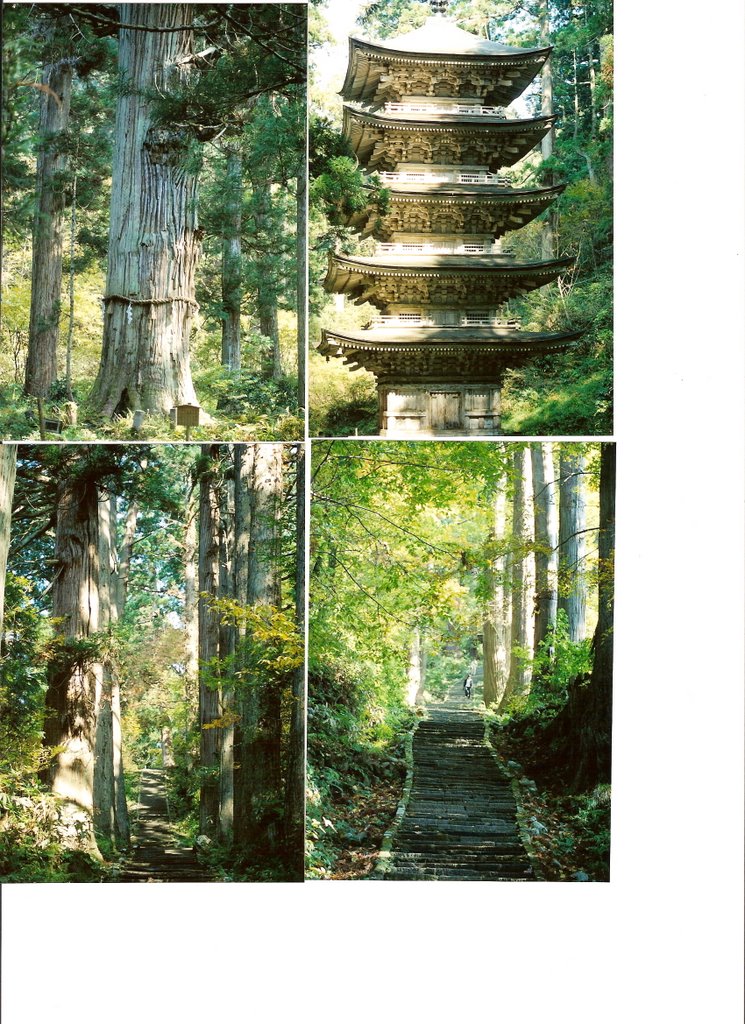
The following photos were taken with a traditional SLR and then scanned. I have not been able to reformat them, wherefore the space at the margins. Nonetheless, they clearly show Haguro's Five-Story Pagoda, oldest in the Tohoku area; the massive, 1000-year-old cryptomeria, designated a National Treasure; and, the cryptomeria lined, stone-paved approach to the shrine at mountain's top.
Thursday, January 04, 2007
Basho in Yamagata

Basho's pilgrimage through Yamagata took him to the three mountains of the Dewa Sanzan range:Yuudono, Gassan, and Haguro. Haguro, whose name means "Black Feather", is famed for its avenue of lofty cryptomerias. Most, at 300 hundred years of age, have only just reached maturity, at least so think their 500- year-old elders, of whom a number line the shrine's approach. But the great-granddaddy of them all, a mighty Methuselah just into his second millennium, deigns not to acknowledge these mere saplings. For has he not been declared a National Treasure, by order of the very Emperor himself? Mention of these has not exhausted Haguro of its store of treasures and oddities. The shrine atop Haguro is approached along an avenue of Japanese cedars, which form a kind of barrel vault overhead. The path itself is paved, from base to summit, with low, shallow steps of stone. Just where they were quarried, or how transported to their present location, is a mystery, to me at least, but that it was a massive undertaking there can be no doubt, for there are 2446 of them, all told!
Tuesday, December 26, 2006
日本語 The Japanese Language
The Japanese language is bestrewn with the corpses of terms unable to resist the onslaught of Western loan words. In this space I shall post belated obituary notices of obsolete Japanese. The index will be updated periodically. Contributions are welcome.
辻自動車: (tsujijidousha) literally, "self-moving vehicle at the street corner", better known as taxi
百貨店:(hyakkaten) "shop of a hundred items", now called depaato, from department store
庭球:(teikyuu) "garden ball", now tennis
玉突き(tamatsuki) "the striking of balls", or billiards
白墨(hakuboku) "white India ink", or chalk
受像機(juzoki) "image receiving machine", or television
写真機(shashinki) "reality-copying device", or camera
羽球(ukyuu) "feather ball", or badminton
受話器(juwaki) "conversation-receiving apparatus", or head-phones
配球(haikyuu) the game of "delivering the ball", or volleyball
辻自動車: (tsujijidousha) literally, "self-moving vehicle at the street corner", better known as taxi
百貨店:(hyakkaten) "shop of a hundred items", now called depaato, from department store
庭球:(teikyuu) "garden ball", now tennis
玉突き(tamatsuki) "the striking of balls", or billiards
白墨(hakuboku) "white India ink", or chalk
受像機(juzoki) "image receiving machine", or television
写真機(shashinki) "reality-copying device", or camera
羽球(ukyuu) "feather ball", or badminton
受話器(juwaki) "conversation-receiving apparatus", or head-phones
配球(haikyuu) the game of "delivering the ball", or volleyball
Sunday, December 24, 2006
Tetrapods at Work
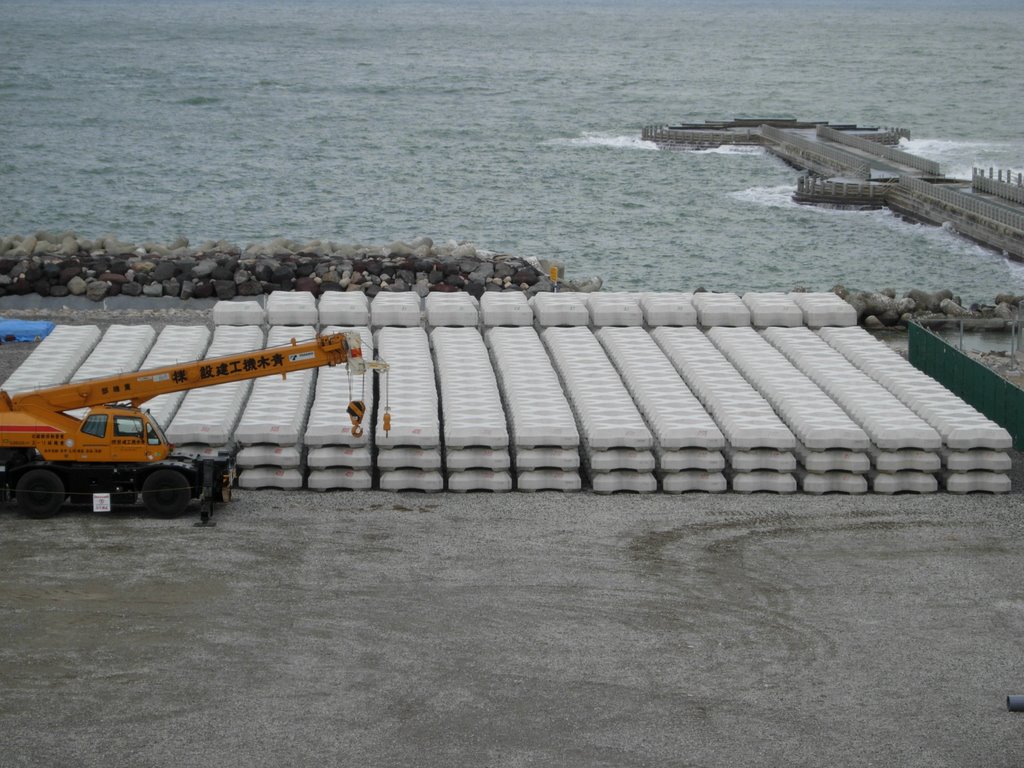
A Tetrapod Farm

Tetrapods are a Showa Era innovation and emblematize the natural catastrophe that is one characteristic of Japan's encounter with the Western World. Donald Richie, longtime expat and insightful translator of Japanese culture, laments the suspension of the "truce" which formerly existed between Japan and Mother Nature. In other words, whereas until the early 20th century the Japanese implicitly acknowledged limitations on their ability-and the desirability thereof-to alter or manipulate Nature, modern Japan admits no such restrictions. For instance, coastal areas subject to extremes of violent weather and which, in times bygone, were wisely deemed off-limits to development, are now depressing (and expensive) examples of capitalism run amok. To protect private property and the infrastructure that makes it possible(as well as to subsidize the local cement people), erosion control measures, chiefly in the form of tetrapods, have been implemented along vast stretches of Japan's coastline. But not even the mighty tetrapod can protect coastal roads and other beachfront development from typhoon-generated storm surge or tidal waves produced by boreal winds, for every year construction crews rush to repair damage inflicted by inclement weather. With the fate of the Earth's ecosystem hanging in the balance, let us hope that Japan returns to her roots and lights the world's way forward to a sustainable co-existence with all of creation.
Wednesday, December 20, 2006
Basho and Sora in Niigata


Haiku master Basho and travelling companion Sora left Yamagata for Niigata in early August, 1689. Crossing the Nezu Barrier into Echigo, as Niigata was then known, the two made their way to Kaga Province (Ishikawa Prefecture) via Murakami(8/13), Tsuiji(8/15), Niigata City(8/16), Izumozaki(8/18), Naoetsu(8/20), Takada(8/22), Noh (8/25), and Ichiburi (8/26). The approximate distances (in kilometers) between towns are as follows: Murakami-Tsuiji, 30K; Tsuiji-Niigata, 40K; Niigata-Izumozaki, 60K; Izumozaki-Naoetsu, 30K; Naoetsu-Takada, 10k; Takada-Noh, 15K; Noh-Ichiburi, 30K. Crossing the Ichiburi Barrier, Basho and Sora entered Toyama. Kaga was three days distant.
Tuesday, December 19, 2006
Basho-do Photos


The following photos show Niigata City's Basho Monument, a site commemorating haiku founder Matsuo Basho's visit to the city on 16 August, 1689. During their 奥の細道 pilgrimage, Basho and travelling companion Sora spent little time in Niigata, regarding Echigo Province (as Niigata was then known) as an unavoidable evil to be endured. During the three weeks Basho and Sora followed the treacherous "North Country Road" along the Japan Sea coast, only one poem was composed. On August 18, Basho wrote the following poem at the small port of Izumozaki.
O'er wild ocean spray/ All the way to Sado Isle/ Spreads the Milky Way!
Monday, December 18, 2006
Basho in Niigata


Matsuo Basho, father of the verse form haiku, set off from Edo (Tokyo) in May of 1689 on a pilgrimage to Japan's northern provinces. Accompanied by his disciple Sora, the two covered some 2400 kilometers, mostly on foot, during the ensuing five months. Their peregrinations took them along the Sea of Japan coast later that year, in August . Following the Hokuriku Road southwest from Yamagata Prefecture, the poets made few stops-and penned even fewer haiku- while in Echigo Province, as Niigata was then known. Nevertheless, Basho composed a fine poem in the village of Izumozaki, a small port sixty-odd kilometers from Niigata City. The following translation is by Dorothy Britton.
O'er wild ocean spray/ All the way to Sado Isle/ Spreads the Milky Way!
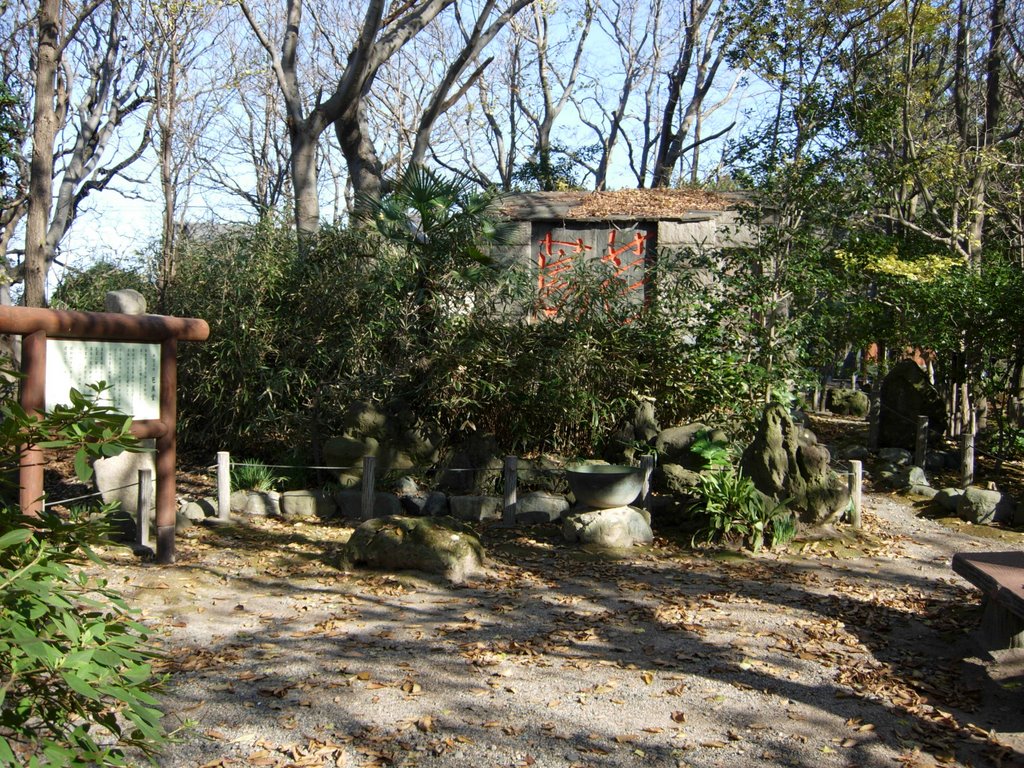
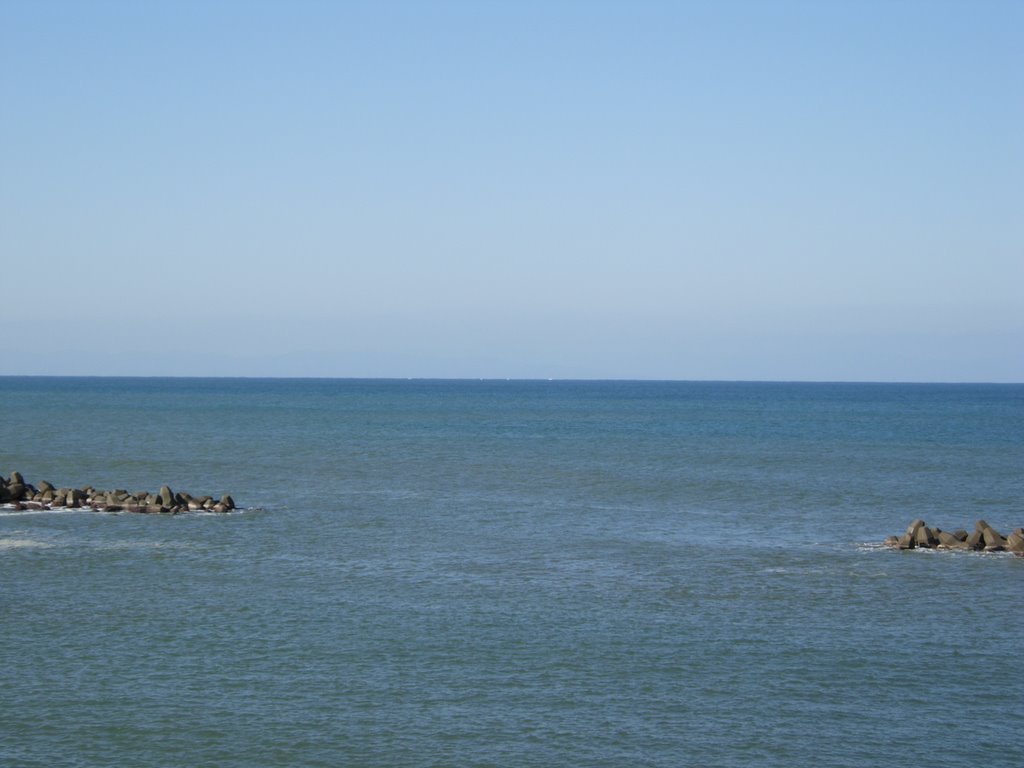
Though Niigata City itself cannot boast of having inspired the master's muse, the city honors Basho with a fine monument, the Basho-do, located on a promontory overlooking the sea. In clear weather, 佐渡ヶ島, the Sado Isle of Basho's poem, is clearly visible 65 kilometers away.
The photos show Basho-do and its setting in a copse of trees, as well as a nearby view of the Japan Sea. Incidentally, the Basho Memorial is in the vicinity of the site of Megumi Yokota's abduction.
Saturday, December 09, 2006
The Remains of the School Day


A brief discussion of extra-curricular activities shall complete my description of a typical day at Kido JHS. As was remarked in a previous post, club activities constitute a central part of the middle school experience in Japan. In fact, club participation at the 12 Niigata City junior high schools at which I have so far taught has averaged close to 90% of total student enrollment. Kido JHS is no exception. There is a club for nearly every interest and temperament, as the following enumeration demonstrates. For boys as well as girls, there are the art, band, track and field, kendo, basketball, science, and computer clubs. Clubs exclusively for boys include soccer, baseball, table tennis, and soft tennis. For girls, there is volleyball, softball, badminton, or rhythmic gymnastics. Students who participate in extra-curricular activities choose a single club and remain there- or, to paraphrase Mark Twain, put their eggs in a single basket, and proceed to watch it. In Japan, there are no school sports seasons, properly speaking. Therefore, students practice with their club year-round. At Kido JHS, clubs meet until 5:00 PM in winter, but from late spring to late fall, practice ends at 6:00. One result of the emphasis on a single club is that the art and band clubs are, on average, far superior to their American counterparts. Alternatively, I often meet athletically talented students who are highly accomplished in their club sport but who, owing to the limitations of the Japanese system , are remarkably inept at other athletic activities. Kido's gym is shown above. Note the absence of bleachers, which is typical of Japanese school gyms. Spectators use the narrow, second story gallery. One of Kido's two soft tennis courts is also pictured. Soft tennis is a form of tennis that originated in Japan. It is played on a sanded court, with racquets that are slightly smaller than the ordinary. Moreover, the racquets are strung at a tension of about 30 lbs., somewhat less than that for standard racquets. The ball used in soft tennis is approximately the size of a regular ball, minus the felt. Lastly, the net is raised a few inches higher than for the hard-court game. Soft tennis is a rather forgiving form of the sport, a direct result of the string tension, as well as the cushiony quality of the ball. Simply put, a mis-hit will often land in play. While soft tennis is easier to learn than the hard court style, one wonders whether the lack of opportunities for young Japanese to play hard court tennis doesn't partly account for the dearth of Japanese on the pro circuit.
Saturday, December 02, 2006
The School Day- After Lunch

Lunchtime and the noon recess have ended, and the bell announcing the start of fifth period sounds. Three days a week, the fifth class is a followed by a sixth. Five minutes after the final class ends, school cleaning begins. The students clean the school themselves. They are assigned work stations, and in brigades of 5 to 8 students, proceed to sweep, scrub, and otherwise tidy up the school. Excepting the restrooms, which are cleaned at Kido JHS by a professional cleaning firm; the equipment storage rooms, which are seldom cleaned; and the teachers' locker rooms, no corner of the school remains untouched. At some schools (Kido is not among them), the students pick up litter that has collected on the school grounds. All of this is done to the accompaniment of music. A digression is called for here. The jingle played over the PA system during cleaning time is of a genre that would seem to have been created for the express purpose of stimulating the students into a sort of cleaning frenzy. Fast paced and instrumental, the tune is not something one would hear on the radio, or find on a compilation at the local CD shop, or hear anywhere outside of the particular school at which it is played. I have now taught at 12 junior high schools in Niigata City, and no two have played the same cleaning tune. Consider that, and ponder the tremendous business opportunities that await the producers of such recordings. Their cleaning done, the brigades hold short meetings with their supervising teacher to evaluate work performance. After that, it's back to the classroom for the afternoon homeroom meeting. This concluded, it is time for club activities, to participate in which is the primary reason some students attend school at all. A final note: you may be wondering whether there are no janitors at Japanese schools. Janitors there are none, but rather handymen, who maintain the school grounds and make simple repairs. They tend to keep to themselves, being provided their own comfortable room just inside the entrance to the school.
Subscribe to:
Posts (Atom)